# Chat widget
> **What you will learn**
> How the window you embed in a website works, and what changes because it is a
> public entrance.
## A chat window on your own site
A place where visitors can ask questions directly from your homepage.
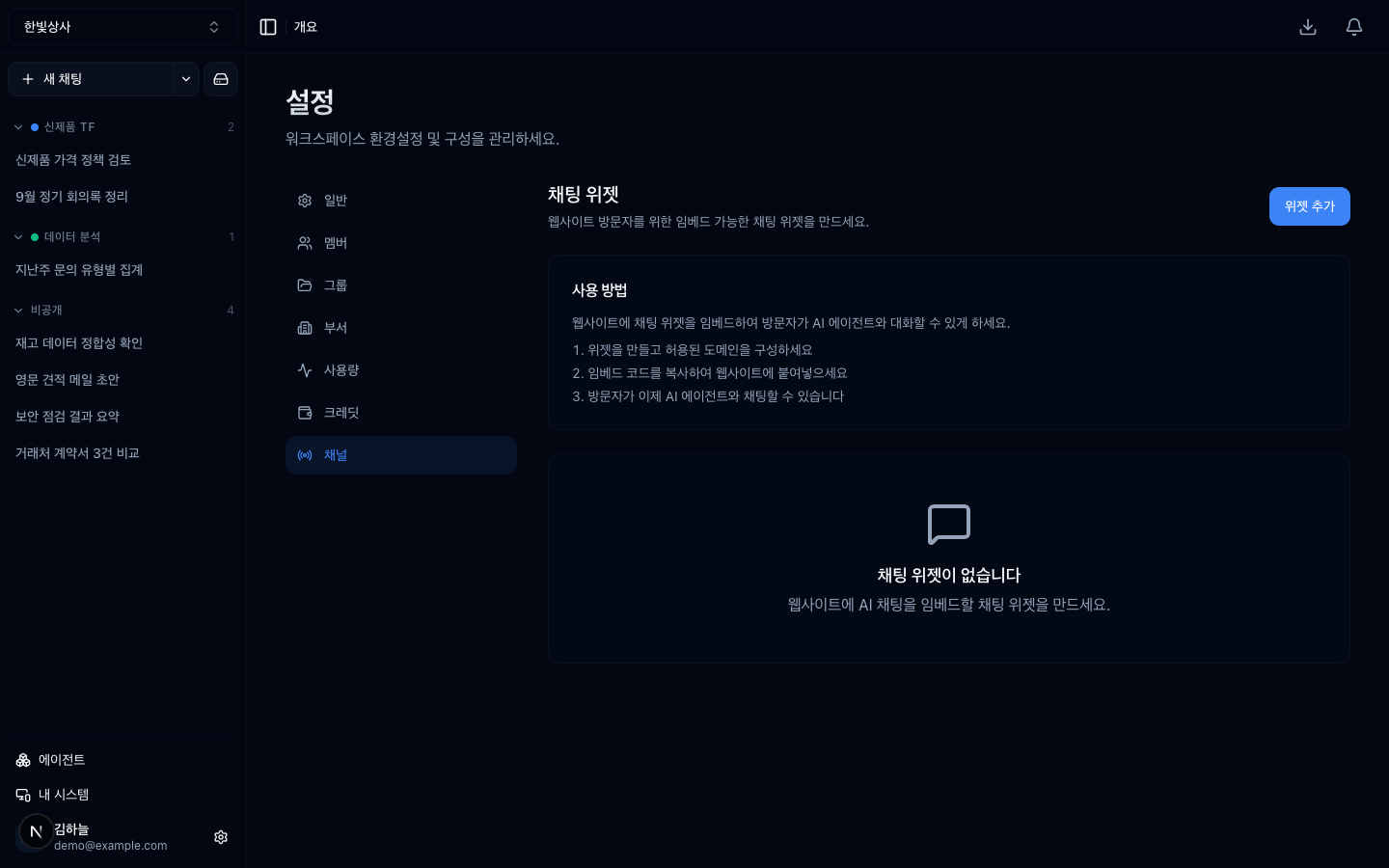
Structurally it matches [email agents](/guide/cn-email-agents); **only the
entrance differs.**
| | Email | Widget |
|---|---|---|
| Entrance | a mail address | a script embedded in a web page |
| Response | a reply email | on screen immediately |
| Visitors | whoever knows the address | **anyone who visits the site** |
**That last row changes the design.** A widget is a far more open entrance than
email.
## Embedding it
Creating a widget issues a **widget key.** Put the script containing that key
into a web page and you are done.
```
1. Create the widget → key issued
2. Set allowed domains (required)
3. Insert the script into your site
```
## The domain restriction is the point
The widget key is **exposed in the page source.** It cannot be hidden. Anyone can
read and copy it.
So **allowed domains are the only line of defence.**
```
✗ No domain restriction
→ copy the key onto any site and it works there
→ someone else's site runs support at your cost
✓ Your domain only
→ pasting it elsewhere does nothing
```
> **Set the domain when you create the widget.** Put it off and the key spreads
> in the meantime.
## Requests per minute
You can set a **per-minute request limit.**
On a busy site, without it, one person leaving the window open and sending
repeatedly is enough to raise your cost. **Always set it on a public entrance.**
## Collecting email
Turn **email collection** on and visitors give their address before chatting.
| | On | Off |
|---|---|---|
| Friction | higher (more drop-off) | low |
| Follow-up contact | possible | not possible |
| Personal data | **you now collect and store it** | none |
**Do not treat the third row lightly.** Taking an email means holding personal
data from that moment, which brings a privacy policy, a retention period, and a
deletion procedure. **Turn it on only when follow-up is genuinely needed.**
## What to do differently because it is public
### 1. Minimum tools
If internal document search is open to the widget, **internal material becomes
the raw material for visitors' questions.** Connect only material that is
acceptable to publish.
### 2. Write the boundaries into the instructions
```
[Role]
You answer enquiries about our products.
[What not to do]
- Do not promise discounts or contract terms
- If unsure, say you will confirm with the responsible person
- Do not mention internal schedules or unreleased products
```
**Blocking promises matters most.** What goes out of a public window reads as
something the company said.
### 3. Give it its own group
Widget conversations pile up. Collecting them in a dedicated
[thread group](/guide/cn-groups) keeps the team's sidebar from being buried.
## What to watch
The screen records **total sessions** and **last used.**
```
□ did session count suddenly rise (it may be embedded on someone else's site)
□ is last-used too long ago (the script may have been removed)
□ is cost higher than expected
```
**The first is your signal to check the domain restriction.**
---
## Check yourself
**1. The widget key cannot be hidden — so how do you protect it?**
Answer
**The allowed-domain restriction.** The key is exposed in the page source and
cannot be concealed, but with domains set, pasting it on another site does
nothing.
**2. Why turn on email collection carefully?**
Answer
**Because you take on responsibility for holding personal data**, which brings a
privacy policy, a retention period, and a deletion procedure. Turn it on only
when follow-up is genuinely needed.
**3. What must the widget instructions block above all?**
Answer
**Promises** — discounts and contract terms. What goes out of a public window
reads as something the company said.
---
Next, the files that accumulate in a workspace → [Drive](/guide/cn-drive)