# Members and roles
> **What you will learn**
> How to invite, the difference between the three roles, and how to allocate
> them in practice.
## Inviting
Invite by email under **Settings → Members**.
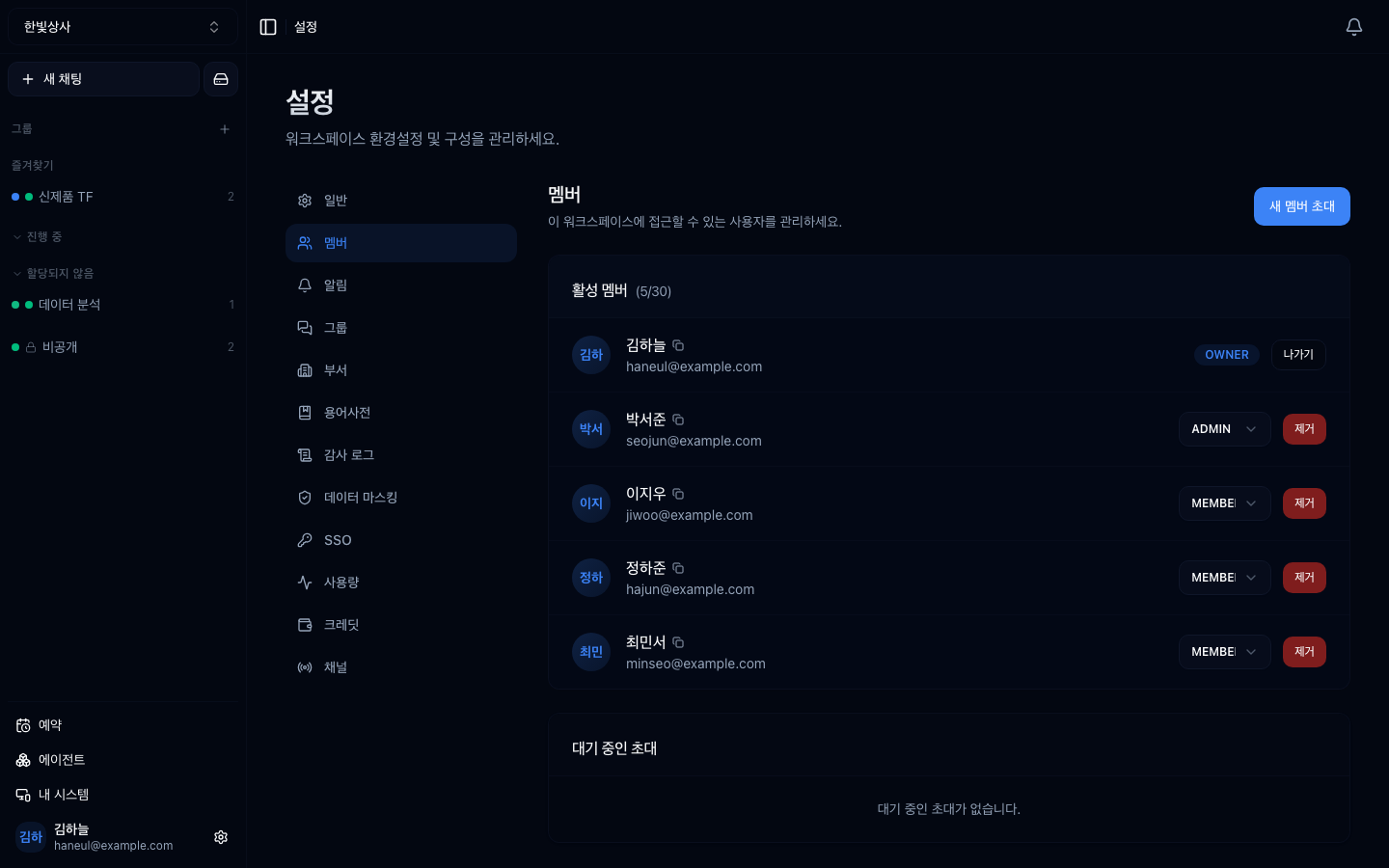
Invitations go out as an email link and stay under **pending invitations** until
accepted.
## The three roles
| Role | What they can do |
|---|---|
| **owner** | everything, including deleting the workspace and billing |
| **admin** | team settings and most admin screens. But not billing, deletion, or system registration |
| **member** | converse and use agents. Admin screens are blocked |
### Specifically
| Can they | owner | admin | member |
|---|---|---|---|
| Converse, use agents | ○ | ○ | ○ |
| Create agents | ○ | ○ | ○ |
| Invite members, change roles | ○ | ○ | ✗ |
| Configure tool connections | ○ | ○ | ✗ |
| View the systems screen | ○ | ○ | ✗ |
| **Register a system, change its policy** | ○ | ✗ | ✗ |
| Purchase credits | ○ | ✗ | ✗ |
| Delete the workspace | ○ | ✗ | ✗ |
> **Systems are the exception.** An admin can see the list of registered systems
> and their status, but **the register and policy-edit buttons are not shown to
> them.** Attaching a new machine has to be done by the owner.
## How many admins
This is where practical judgement is needed.
| Setup | Problem |
|---|---|
| One owner only | **when they are away**, system registration and tool settings all stop |
| Everyone an admin | the permission boundary disappears. Hard to trace who changed what |
| **1 owner + 1–2 admins** | **sensible** |
> **A single owner is the most common problem.** If a tool connection breaks
> while they are on holiday, the whole team waits.
## Deciding a role
```mermaid
graph TD
Q["Give this person admin?"] --> Q1{"Do they need to configure
tools and systems themselves?"}
Q1 -->|"yes"| A["admin"]
Q1 -->|"no"| Q2{"Do they manage members?"}
Q2 -->|"yes"| A
Q2 -->|"no"| M["member"]
```
**Conversing and creating agents needs only member.** Give admin only to people
who change settings.
## What to do alongside inviting
Invite someone with no guidance and they arrive not knowing what to do.
```
□ what this workspace is for
□ the list of available agents and what they are for
□ what not to do (no personal data, and so on)
□ who to ask when stuck
```
**Sending a guide link along works too** — starting from
[your first conversation](/guide/cn-first-chat).
## Leaving and removing
| Situation | How |
|---|---|
| You leave yourself | **Leave** on the members screen |
| Removing someone else | **Remove** (admin or above) |
| Changing the owner | designate a new owner, then the old one leaves |
**Do not forget to clear out leavers.** While they remain in the workspace they
keep access to the conversation history.
## Periodic review
About once a quarter:
```
□ does the member list match the actual team
□ are there more admins than necessary
□ are there accounts that have not been used in a long time
```
---
## Check yourself
**1. What goes wrong with only one owner?**
Answer
**When they are away**, administrative work like system registration and tool
configuration all stops. One owner plus one or two admins is sensible.
**2. What role do you need to create an agent?**
Answer
**Member is enough.** Give admin only to people who change settings — tool
connections, system registration, member management.
**3. What should you tell someone when inviting them?**
Answer
**The workspace's purpose, the available agents, what not to do, and who to ask.**
Invite them with no guidance and they arrive not knowing what to do.
---
As headcount grows, per-person management breaks down →
[Groups and departments](/guide/cn-groups)