# SSO and department sync
> **What this chapter covers**
> That SSO opens more than sign-in, how to map IdP groups to departments, and why
> this is a security-review gate.
## Two things arrive together
**Settings → SSO** covers two things.
| | What | Set where |
|---|---|---|
| **Sign-in** | Coming in with a company account | Deployment settings (`OIDC_*`) |
| **Department sync** | IdP group → [department](/guide/cn-groups) | This screen |
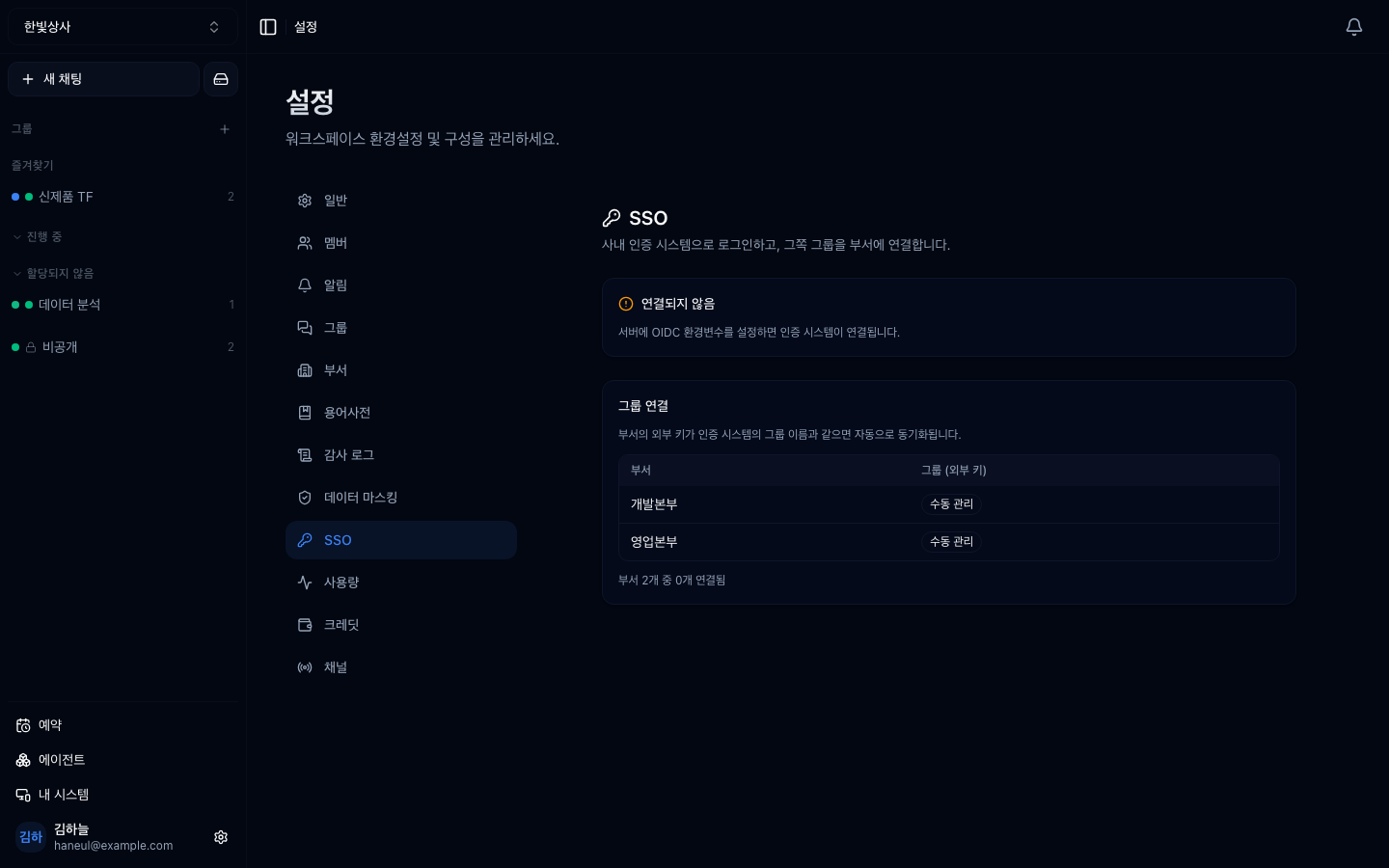
Sign-in itself is wired up by whoever runs the deployment. **What the workspace
actually gains is the lower half** — everyone's department is corrected on each
sign-in.
## Why department sync is the value
Departments are **the unit permissions are granted to** in this product.
```
Drive folder permissions → by department
Group visibility → by department
Operator (run) rights → by department
```
Grant those to individuals and every staff move means editing **dozens of
screens** by hand. Grant to departments, and have departments follow the IdP, and
HR moving one person in the IdP is the whole job.
> **Leavers work the same way.** Deactivate in the IdP and the next sign-in is
> blocked, taking the department membership with it.
## Wiring it up
The screen shows whether an IdP is attached and which claim groups are read from.
```
□ Connection status — is it attached
□ Issuer URL — which IdP
□ Groups claim name — defaults to groups
```
Below that you give each department an **external key**. It must match the group
name the IdP sends.
| Department | External key |
|---|---|
| Sales | `sales` |
| Engineering | `engineering` |
**Match case and spacing exactly.** One character off and it silently fails to
link — and the symptom shows up as "no permission".
## Tier
A Business-tier feature ([Plans and tiers](/guide/cn-plans)).
Note its character: **this is not a feature people want, it is a condition for
passing a security review.** "Do we have to create separate passwords outside our
company identity system?" comes up in almost every enterprise review, and failing
it means the rest is never evaluated.
## On-premises
No tier limit — but the IdP itself has to live inside that network.
## Common misunderstandings
### "Does enabling SSO block email sign-in?"
**That depends on deployment settings.** This screen handles department sync;
which sign-in methods are open is set per deployment (`OIDC_*`). During a
transition it is normal to leave both open.
### "Do we have to recreate departments to match the IdP?"
**No.** Give existing departments an external key. Departments the IdP doesn't
know stay manually managed, and the two mix freely.
---
## Check yourself
**1. What does the workspace actually gain here?**
Answer
**The sync that turns IdP groups into department membership.** Sign-in itself is a
deployment setting; this screen handles what comes after.
**2. Why does department sync make permissions cheap?**
Answer
**Because drive, group and operator rights are all granted to departments.** HR
moving someone in the IdP moves their whole access footprint.
**3. What happens when an external key is one character off?**
Answer
**It silently fails to link.** There is no error — it shows up as "no permission",
which is hard to trace. Match case and spacing exactly.
---
Next, where to look when something breaks → [Troubleshooting](/guide/cn-troubleshooting)