# Turning documents into material
> **What you will learn**
> How to turn document files into something an agent can work with, and the
> relationship between the original and the copy.
>
> **If file formats and encodings are unfamiliar,** start with [Shapes of data](/guide/it-data-formats).
## The problem — documents are not readable as-is
PDFs and spreadsheets can pile up in a working directory without an agent being
able to work with them. The fundamental way to
[reduce hallucination](/guide/ai-hallucination) is "give it material and have it
answer from within that" — and **the material has to be in a readable form.**
## You make a text copy
A **markdown copy** sits beside the document.
```
business-plan.pdf
business-plan.pdf.md ← the copy
```
That it is **`business-plan.pdf.md`** rather than `business-plan.md` matters. The
original name is kept whole, so **you know which file a copy came from** by name
alone.
## Four formats
| Extension | |
|---|---|
| `pdf` | documents, reports, proposals |
| `docx` | Word |
| `xlsx` | Excel |
| `pptx` | PowerPoint |
**Only these four.** It decides by extension, so the name has to be right.
## PDF differs from the rest
A frequently missed point.
```mermaid
graph TD
A["Original document"] --> B{"Which kind?"}
B -->|"PDF"| C["The copy is a supplement
tables and figures need the original"]
B -->|"docx · xlsx · pptx"| D["The copy is everything
the original cannot be read"]
```
| | PDF | docx · xlsx · pptx |
|---|---|---|
| Can it read the original | **yes** (by page range) | no |
| Role of the copy | **supplement** — search and summary | **everything** |
| Tables and figures | check the original for accuracy | only what made it into the copy |
> **Find in the copy, confirm in the original — for PDFs.** Locate "there is a
> revenue table on page 3" in the copy, then have it read page 3 of the original
> for the exact figures. **For spreadsheets the copy is everything**, so a poor
> copy is the end of it — important figures need a human check.
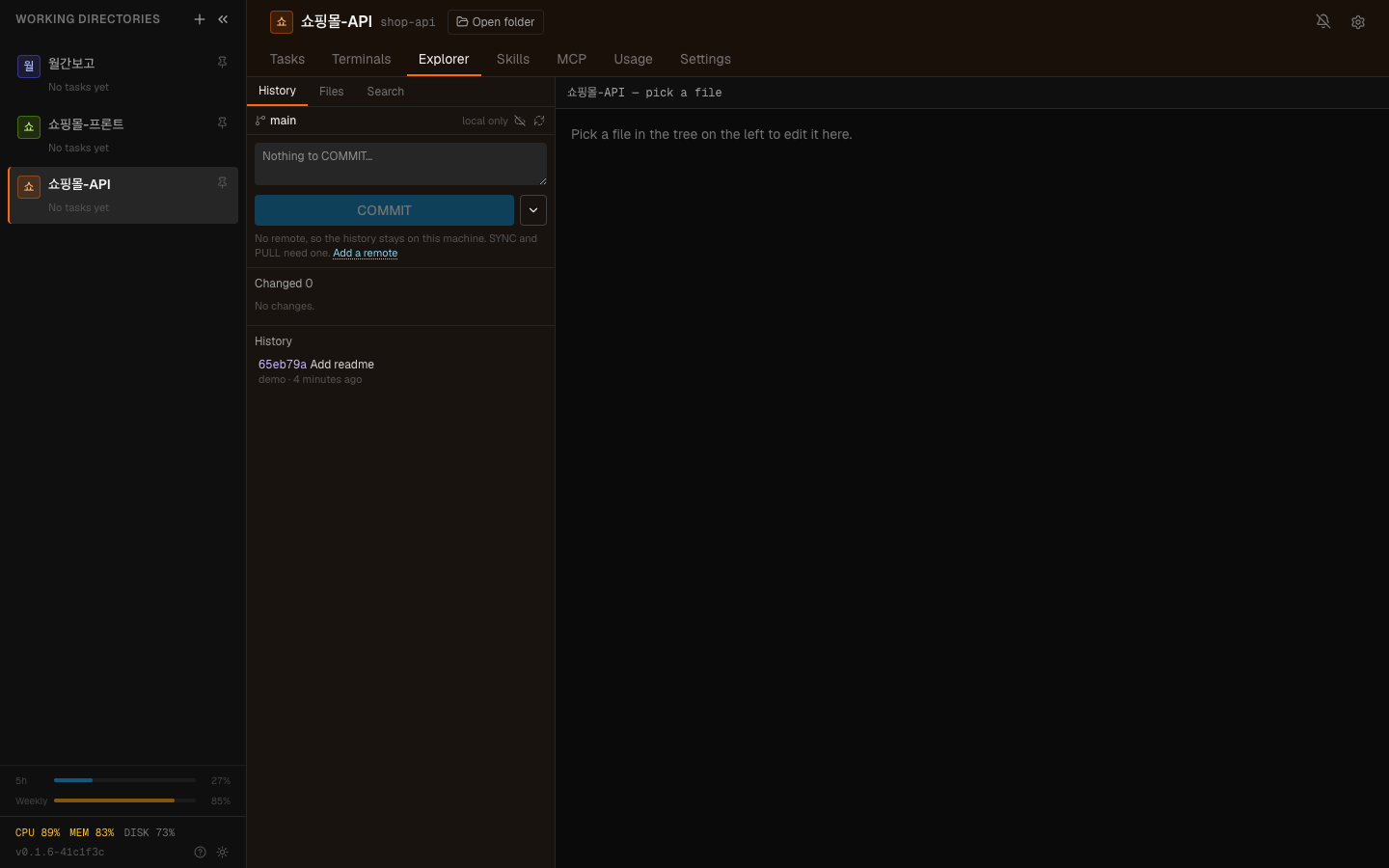
The Explorer tab shows the folder's files, and is where you make text copies from documents.
## When copies are made
| Trigger | Scope |
|---|---|
| When you upload files | only what you uploaded |
| Selecting a file directly | that one file |
**Not sweeping a whole folder is the default.** Descending through everything
converts unrelated documents too, and on a large folder that takes a long time.
If a copy exists and the original has not changed, **it is not remade.** You can
force a rebuild — for when you edited the original and the copy is stale.
## Searching files
Once copies exist, **you can search by content.**
```
"Find last year's contracts with no cap on damages"
```
That request does not work with only the original PDFs. The copy is what search
catches.
> **For a working directory heavy with documents, making copies is step one.**
> Skip it and every summary request reads whole files, which
> [fills the context](/guide/ai-context-overflow).
## The practical flow
The typical order for a document-heavy folder:
```
1. Gather documents into the working directory
2. Make copies
3. Search the copies to narrow to relevant documents
4. Have only the narrowed set read closely
5. Verify the result (especially figures)
```
**Step 3 is the key.** Rather than reading all 100 documents, you narrow to 3 and
read those. Same principle as
[when you have too many tools](/guide/mcp-too-many-tools) — **reducing candidates
raises accuracy.**
## How git fits in
If the working directory is a repository, decide **what to version.**
| Target | Version it | Why |
|---|---|---|
| Original documents | depends | large. Fine if they rarely change |
| **Text copies** | **recommended** | small, and the change history means something |
| Generated images and audio | **exclude** | binaries bloat the repository |
Committing the copies makes **when and how a document changed** visible as
history. A changed PDF shows no diff; markdown does.
### Commit messages
Hand committing to an agent and it picks **words that mean something in this
repository** for the subject. It surveys all filenames, ignores names that are
too common, and uses the ones that actually identify an area.
> Rather than maintaining a list of framework boilerplate, it asks the repository
> directly — a name carried by a large share of the files is boilerplate by
> definition.
## Things to watch
### Copies go stale
Edit the original and leave the copy and **the agent confidently states old
content.** Rebuild the copy when you change the original.
### Check tables and figures
Tables are the most fragile part of document conversion. **For any judgement
resting on amounts, dates, or quantities, confirm against the original.**
"Always verify numbers" from
[things to watch out for](/guide/ai-cautions) applies directly.
### Do not just drop sensitive documents in
The moment it is in the working directory,
[that folder's scope is the agent's area of operation](/guide/ht-working-directory).
If the system is [registered to Connect](/guide/cn-systems), workspace members
reach it too.
```
□ should this document be in this folder
□ does it contain personal data
□ is it acceptable for it to be searchable as a copy
```
---
## Check yourself
**1. Why is the copy named `report.pdf.md` rather than `report.md`?**
Answer
**To keep the original name whole so you know from the name alone which file the
copy came from.** Drop the extension and the copies of `report.docx` and
`report.pdf` collide.
**2. How does the copy's role differ between PDF and Excel?**
Answer
**A PDF original can be read directly by page range, so the copy is a supplement
for search and summary**, while **docx, xlsx and pptx originals cannot be read,
so the copy is everything.** With spreadsheets a poor copy is the end of it, so
important figures need a human check.
**3. Why make copies first in a document-heavy folder?**
Answer
**To narrow candidates by search before reading.** Reading all 100 fills the
context and lowers accuracy; narrowing raises it.
---
Now everything joined into one → [Case study — a content factory](/guide/ht-case-factory)