# Your first task
> **What you will learn**
> This is a chapter for **doing**, not reading. We hand over a first task in a
> safe order.
## The safe order
Do not let it edit files from the start. **Climb through three stages.**
```mermaid
graph TD
A["Stage 1: plan only
no execution"] --> B["Stage 2: read-only work"]
B --> C["Stage 3: work that edits files"]
```
---
## Stage 1 — ask for a plan only
From a registered working directory card, create a **new task** and set autonomy
to **plan only.**
```
Understand the structure of this project, and plan what you would
change to improve the README and how.
Do not actually modify anything.
```
### What to check
- A plan appears and **no files change**
- Whether it actually read the project structure to answer
- Whether the suggestions fit your situation
**The purpose of this stage is not the output but seeing what it intends to do.**
If the plan is off, the instruction was insufficient — and you want to know that
before execution.
---
## Stage 2 — read-only work
If the plan looks reasonable, move to real work. Start with **reading and
summarising** only.
```
List the files in this project that have no tests.
Give me a table of the file path and a one-line description of what it does.
Do not modify any files.
```
### What to check
- Whether progress appears **in real time**
- Whether the files it read are shown
- Whether the result matches reality (verify one or two yourself)
**The third matters.** Verifying the result is how you calibrate how far to trust
this tool.
---
## Stage 3 — work that edits files
Now let it actually change something. Start with something **small and easy to
undo.**
```
[Goal]
Bring the "Installation" section of README.md up to date.
[Scope]
- Modify README.md only
- Do not touch other files
[Done condition]
- Matches the scripts currently in package.json
- Commands are in a form you can copy and run directly
[Context]
- This project uses pnpm (not npm)
```
That is [the four parts of a good instruction](/guide/ai-intent-context) applied
directly.
### What to check
- Whether the files it changed are shown
- Whether you can see the changes on screen
- **Whether it respected the scope** (did only README change?)
> **Commit before you start.** If you use git, undoing is easy. Keeping that
> safety net for the first few runs is worthwhile.
---
## What you set when handing over a task
| Item | Description |
|---|---|
| **Working directory** | which folder to work in |
| **Autonomy level** | in detail in [the next chapter](/guide/ht-autonomy) |
| **The instruction** | what to do |
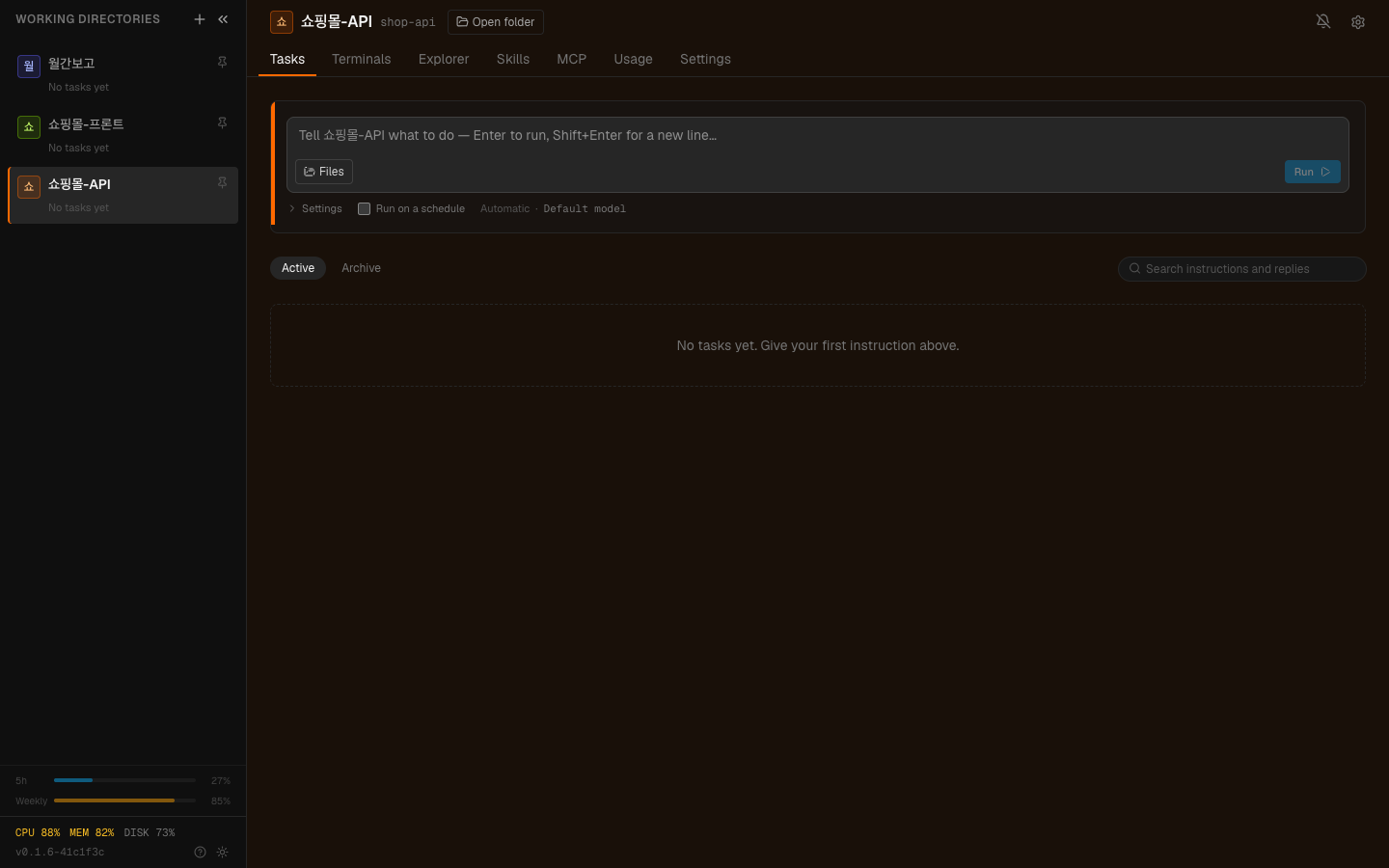
The Tasks tab. Work you hand over stacks as cards with its status.
## Several at once
With several cards you can **hand a different task to each simultaneously.**
```
shop-api → "list files with no tests"
shop-frontend → "find unused components"
docs-cleanup → "turn 3 meeting notes into a table"
```
They all run together and the dashboard shows each one's progress. **That is why
we call it a control room.**
## If you do not like the result
The same as [what you learned in “Your first try”](/guide/ai-first-try) — **keep talking.**
```
Add a "last modified" column to the table.
And exclude the test files themselves from the list.
```
## Common mistakes
### Starting with a big task
Start with "refactor the whole codebase" and you can neither confirm what it did
nor undo it. **Start small and build trust** is the right order.
### Skipping the plan-only stage
Execute straight away and you find out "why did it touch that?" after the fact.
For the first few runs, seeing the plan is much faster.
### Not verifying the result
For the first few, **check the result yourself.** You need a feel for where it is
right and where it goes wrong before you can decide how much to hand over.
---
## Check yourself
**1. Why start with the "plan only" stage?**
Answer
**To see what it intends to do before execution.** If the plan is off, the
instruction was insufficient — and you want to know that before any file changes.
**2. Why verify the result yourself at stage 2?**
Answer
**To calibrate how far to trust it.** Only by verifying can you judge how much to
hand over.
**3. What do you gain by handing tasks to several cards at once?**
Answer
**They run together without waiting on each other.** The dashboard shows each
one's progress, which is why it is called a control room.
---
Now autonomy levels in detail →
[Deciding how much to hand over](/guide/ht-autonomy)