# Directing work over REST
> **What you will learn**
> How to create, watch, and stop work through `/api/v1`, and the one thing you
> must handle when attaching it to automation.
>
> **If requests, responses and status codes are unfamiliar,** start with [Requests and responses — HTTP](/guide/it-http).
## What you did on screen, in code
This does exactly what [your first task](/guide/ht-first-task) did on screen,
over REST. **It calls the same function** — work created on screen and work
created via the API are indistinguishable.
## Five endpoints
| What it does | Request |
|---|---|
| List working directories | `GET /api/v1/workspaces` |
| List tasks | `GET /api/v1/tasks` |
| **Create a task** | `POST /api/v1/tasks` |
| Read one task | `GET /api/v1/tasks/{id}` |
| Follow up | `POST /api/v1/tasks/{id}/follow-up` |
| Stop | `POST /api/v1/tasks/{id}/stop` |
## Creating a task
```bash
curl -X POST http://localhost:27777/api/v1/tasks \
-H "Authorization: Bearer $HT_KEY" \
-H "Content-Type: application/json" \
-d '{
"workspaceId": 3,
"prompt": "List the files in this folder with no tests, as a table",
"name": "test coverage check"
}'
```
### What you can send
| Field | Meaning | If omitted |
|---|---|---|
| `workspaceId` | which working directory | effectively required |
| `prompt` | the instruction | you get an empty task |
| `name` | the name shown in the list | auto-generated |
| `engine` | which engine | the default engine |
| `mode` | autonomy level | **fully automatic** |
| `model` | which model | the default model |
> **Omit `mode` and you get [fully automatic](/guide/ht-autonomy).** The same
> default as on screen. For unattended automation you should know what that
> means before leaving it out.
### Where the working directory number comes from
```bash
curl -H "Authorization: Bearer $HT_KEY" \
http://localhost:27777/api/v1/workspaces
```
You get numbers along with paths. **Do not hardcode the number — look it up by
path.** Delete and re-register a folder and the number changes.
## There is no idempotency key
The most important part of this chapter.
> **Send the same request twice and you get two tasks.**
This is not an omission but **a deliberate design.** The code comment states the
reason — *a REST caller only has to send its request once, and we do not pretend
to offer a guarantee we do not have.*
### So what happens in automation
```mermaid
graph TD
A["Script POSTs"] --> B{"Did a response arrive?"}
B -->|"yes"| C["Fine"]
B -->|"timeout"| D["Retry?"]
D -->|"blind retry"| E["2 tasks created
both edit files"]
D -->|"check first"| F["Safe"]
```
**A timeout is not the same as a failure.** The request may have arrived and only
the response been lost. Retrying in that state runs the same work twice.
### How to handle it
```
□ Check GET /api/v1/tasks before retrying
□ Put a unique value in name so duplicates are visible
□ Cap the number of retries (never retry forever)
□ For work that edits files, make retries a human decision
```
**Using `name` is the most practical route.**
```json
{ "name": "daily-check-2026-08-15" }
```
Put the date or a run identifier in the name and you can **check whether it
already exists** before retrying.
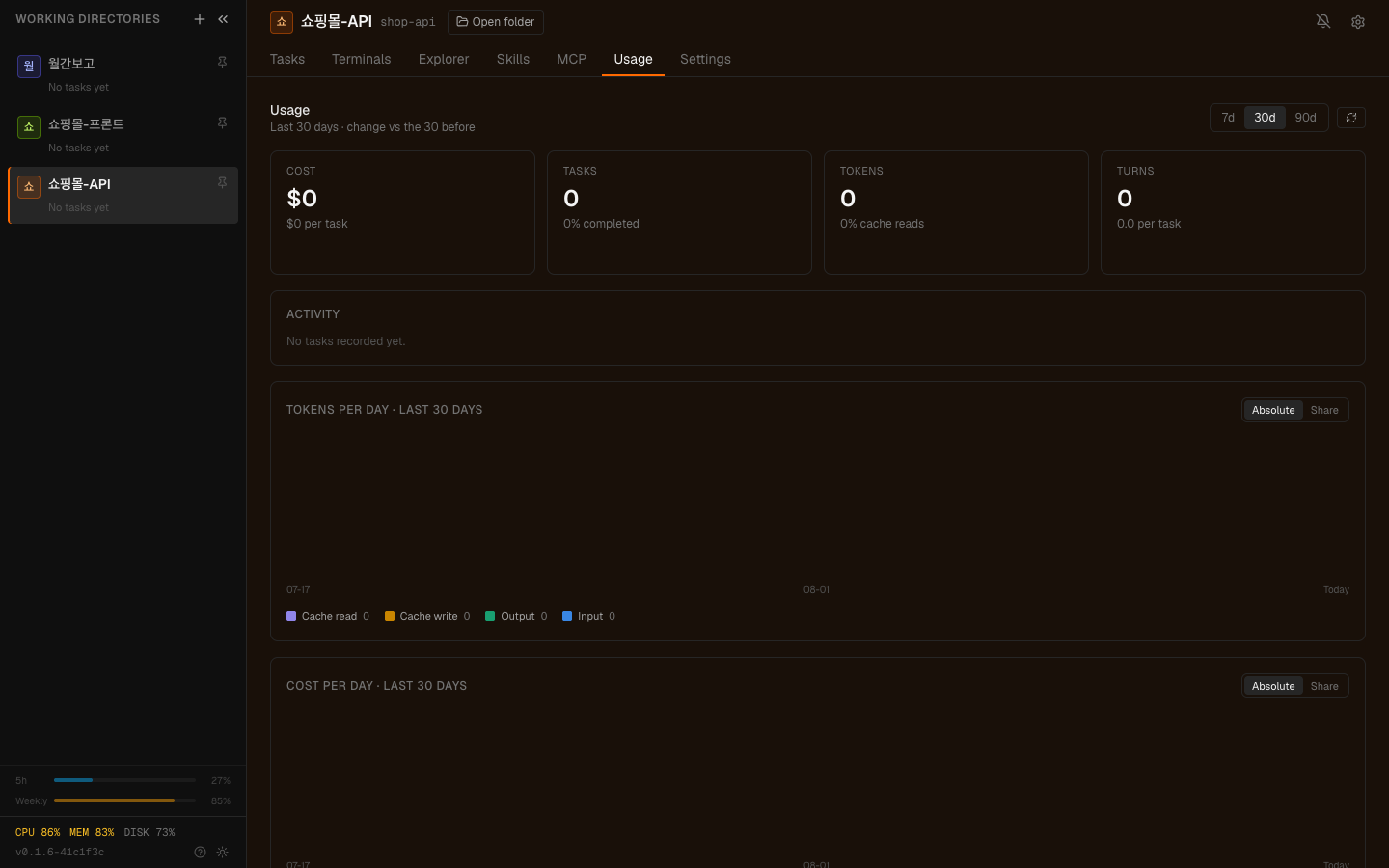
The Usage tab shows what this machine spent, and on what.
## Watching progress
Creating a task returns an identifier. Use it to poll.
```bash
curl -H "Authorization: Bearer $HT_KEY" \
http://localhost:27777/api/v1/tasks/42
```
For long-running work, **poll generously.** Prodding every second gains nothing.
| Duration | Interval |
|---|---|
| Seconds | 2–3 seconds |
| Minutes | 15–30 seconds |
| Hours | several minutes |
## Follow-up and stop
```bash
# When the result is not quite right — same as following up on screen
curl -X POST http://localhost:27777/api/v1/tasks/42/follow-up \
-H "Authorization: Bearer $HT_KEY" \
-H "Content-Type: application/json" \
-d '{ "prompt": "Add a last-modified column to the table" }'
# When it is going the wrong way
curl -X POST http://localhost:27777/api/v1/tasks/42/stop \
-H "Authorization: Bearer $HT_KEY"
```
**Always wire `stop` into automation.**
[Agents go just as hard in the wrong direction](/guide/ai-agent-basics). In
unattended automation, something has to stop it when it exceeds a time or cost
ceiling.
## Where to use it
| Situation | Shape |
|---|---|
| A button on the intranet | button → POST → show the result |
| Issue tracker integration | issue created → task created |
| A regular batch | scheduler → POST → email the result |
| A chatbot | message → task → reply |
> **For regular runs, [scheduling](/guide/ht-pipelines) beats this API.** Keeping
> the scheduler inside the system is easier to manage than one outside. Use the
> API when **an outside event is the trigger.**
## Attaching it safely
```
□ Start with mode fixed to "plan only" and have a person check the results
□ Raise autonomy to the reversible range once you are comfortable
□ Look up workspaceId by path rather than hardcoding it
□ Keep the key in an environment variable — not in code, repos, or logs
□ Watch the created tasks by eye for the first few days
```
**The first line matters most.** Once automation starts editing files it is hard
to undo, and hard to even verify without a
[git commit](/guide/ht-autonomy).
---
## Check yourself
**1. What happens if you send the same POST twice?**
Answer
**Two tasks are created.** The absence of an idempotency key is deliberate, so
whoever adds retries owns the duplicates — check the list before retrying, or put
a unique value in `name`.
**2. What autonomy level do you get if you omit `mode`?**
Answer
**Fully automatic** — the same default as on screen. For unattended automation
you should know what that means before leaving it out.
**3. Why is this API second-best for regular runs?**
Answer
**Because you have to keep a scheduler outside.** The system's own scheduling is
easier to manage. The API is right when an outside event is the trigger.
---
Drive one yourself, duplicate run included. Forty minutes →
[Drive a job over REST](/guide/ht-try-rest)