What this chapter covers What gets hidden, why tokens rather than deletion, and why people can still see the original.
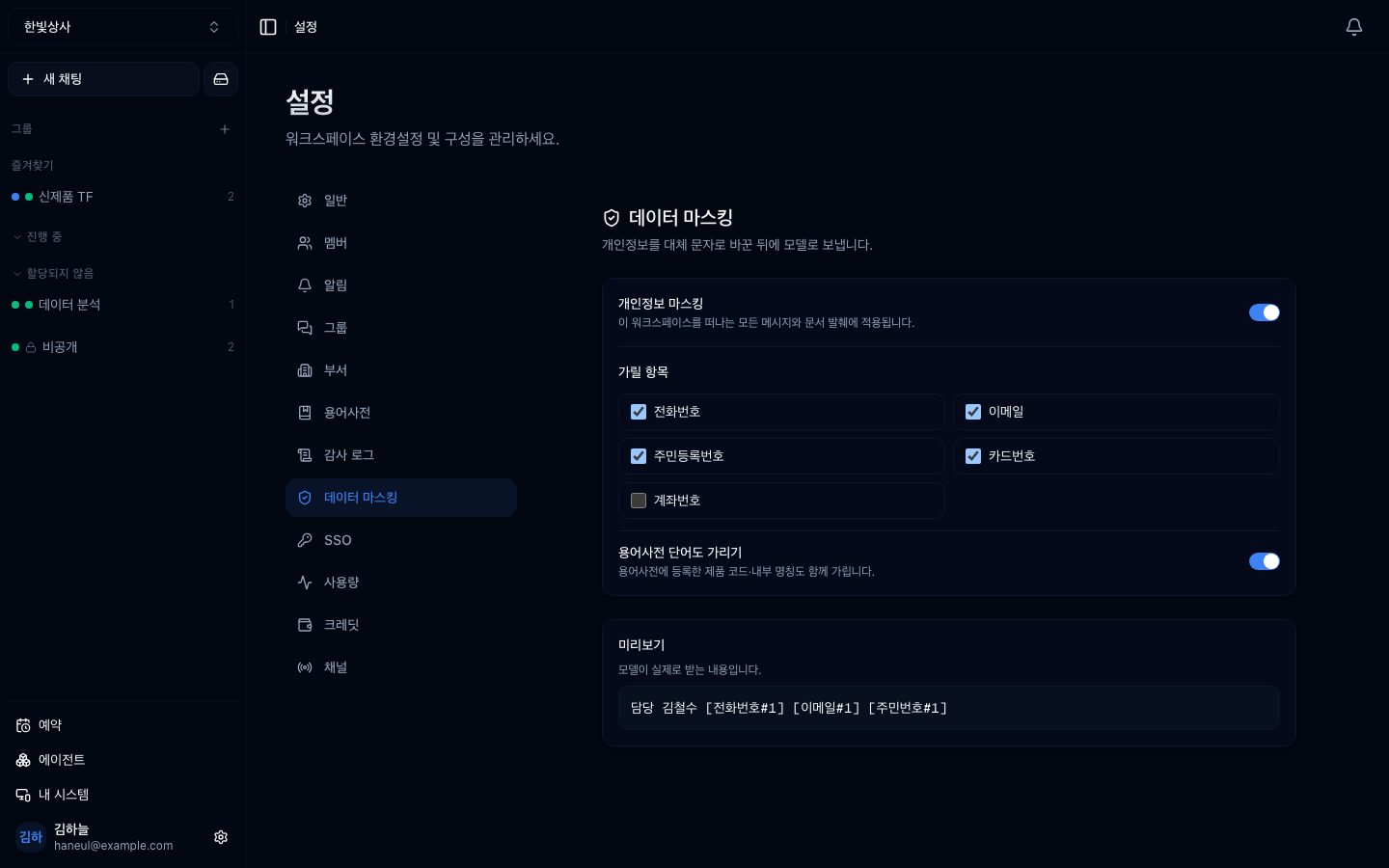
Switch on Settings → Data masking and it applies to every message and document excerpt leaving this workspace.
Flattening to [REDACTED] breaks the sentence so the model cannot read
relationships.
And the same value always gets the same token. If "Acme" becomes
[customer#1] in one place and [customer#2] in another, the model reads two
different companies.
| Item | How it is caught |
|---|---|
| Resident registration no. | Pattern |
| Card number | Pattern |
| Phone number | Pattern |
| Bank account | Pattern |
| Pattern | |
| Glossary terms | Words registered in the glossary |
The last row is half of this feature. Customer names, product codes and internal names cannot be caught by patterns — they differ per workspace, so they cannot live in code. The glossary is that list.
If a phone pattern matched an ID number first, the tail would survive. So more specific rules are checked first — the order you tick the boxes doesn't matter.
The preview at the bottom shows "what the model actually receives" and updates as you tick items. Look at it before switching this on.
The most common misreading.
Masking hides things from the model, not from people.
The substitution dictionary is kept, so authorised users can be shown the original. Hiding things from people is a job for visibility and permissions instead.
A Max-tier feature (Plans and tiers). On lower tiers the screen is locked — but what is locked is the policy screen, not your data.
Everywhere is not the right answer.
| Workspace | Recommendation |
|---|---|
| Customer support, HR, legal | On |
| Anything with external intake (widget, email) | On |
| Internal engineering and planning | Usually unnecessary |
Masking is not free. The model never sees the real values, so work that has to handle the values themselves — validating a phone number format, say — cannot be done in a masked workspace. Split those into their own workspace.
No. It closes one path to the model. Lawful basis, retention periods and deletion procedures all remain (Regulation and compliance).
Drive excerpts take the same path. The original file is untouched though, so anyone who downloads it gets the raw text. That is a drive permissions question.
1. Why tokens rather than deletion?
The sentence structure has to survive for the model to read relationships.
"[customer#1] supplies [customer#2]" keeps the relationship; two [REDACTED]s
carry nothing.
2. How do you mask a customer name?
Register it in the glossary and turn on "mask glossary terms". Patterns cannot catch it, and the value differs per workspace so it cannot live in code.
3. Does masking hide things from teammates?
No. It hides things from the model. Hiding from people is visibility and permissions.
Next, what gets recorded → Audit log
Original: Contact Kim 010-1234-5678 [email protected]The model gets: Contact Kim [phone#1] [email#1]✓ "[customer#1] supplies [customer#2]" → the relationship survives✗ "[REDACTED] supplies [REDACTED]" → no information at all HyperTeams