What this chapter covers Why search misses your company's words, what to register, and how this connects to masking.
An agent answers by finding material and attaching it. But people ask using different words from the ones in the documents.
The document says: "inventory turnover"The person asks: "why did ITR drop?"→ same thing, and search cannot connect themThe glossary is the table that ties them together.
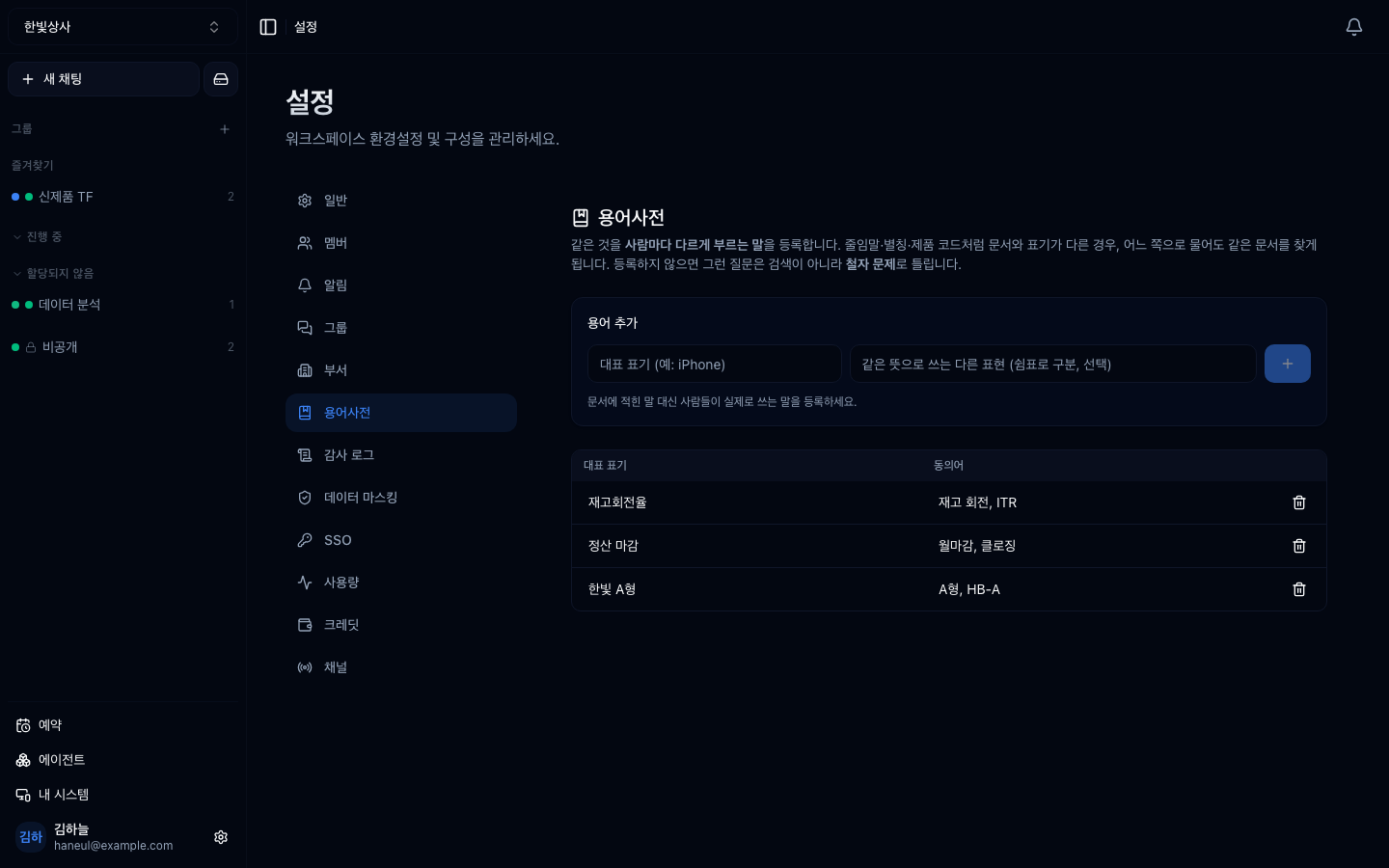
| Canonical | Aliases |
|---|---|
| Inventory turnover | inventory turn, ITR |
| Hanbit type A | type A, HB-A |
| Month-end close | monthly close, closing |
Make the canonical form the words that actually appear in documents. Aliases are what people actually type — they don't have to be pretty. The closer they are to a typo, the more they are worth.
An alias belongs to one term only. Adding one already used elsewhere tells you which term has it and refuses. The same abbreviation meaning two things makes search worse, not better.
Running the intake interview by department is fastest — each department has its own abbreviations, which is also why this screen sits next to departments.
"The word search keeps missing" is the best candidate — people have already felt the pain, so the effect is visible immediately.
Looking up "what does this abbreviation mean" is normal daily use. Block reading and nobody learns the glossary exists. Only editing is narrowed to admins.
Turning on "mask glossary terms" in data masking hides these words on their way to the model.
Phone numbers and ID numbers are caught by patterns, but customer names and product codes are not. Those differ per workspace, so they cannot live in code. The glossary is that list.
So this screen does two jobs at once — it makes search work, and it becomes the list of words that must not leave.
The glossary works on every tier. Features that make the product stick are worse off locked (Plans and tiers).
Twenty is enough to see the effect. Don't try to finish it in one sitting. Adding a line each time a search misses is the healthy way for it to grow.
Better not to register it. Merging them breaks search for one of them. Fix the documents to use distinct canonical forms instead.
1. How does the glossary help search?
It ties the words people type to the words documents use. Asking about "ITR" finds documents that say "inventory turnover".
2. Why can't one alias belong to two terms?
Because one abbreviation meaning two things makes search worse. Adding an alias already in use tells you where it is and refuses.
3. Why does masking need the glossary?
Customer names and product codes cannot be caught by patterns. They differ per workspace, so they cannot live in code — the glossary is that list.
Next, the security part → One page for security review
□ things people call by different names (monthly close / closing / month-end)□ products that appear only as codes (HB-A / Hanbit type A)□ metrics said as English abbreviations (ITR / inventory turnover)□ internal-only shorthand (NP-TF / new product task force) HyperTeams