What you will learn What "
/api/aiis OpenAI compatible" means in practice — what you change and what you leave alone.If SDKs or Python are unfamiliar, start with Programs and languages.
Change the base address on an OpenAI SDK and your own machine's models answer.
The code stays. The library stays.
Nothing else changes. Streaming, function calling, your existing code — all as-is.
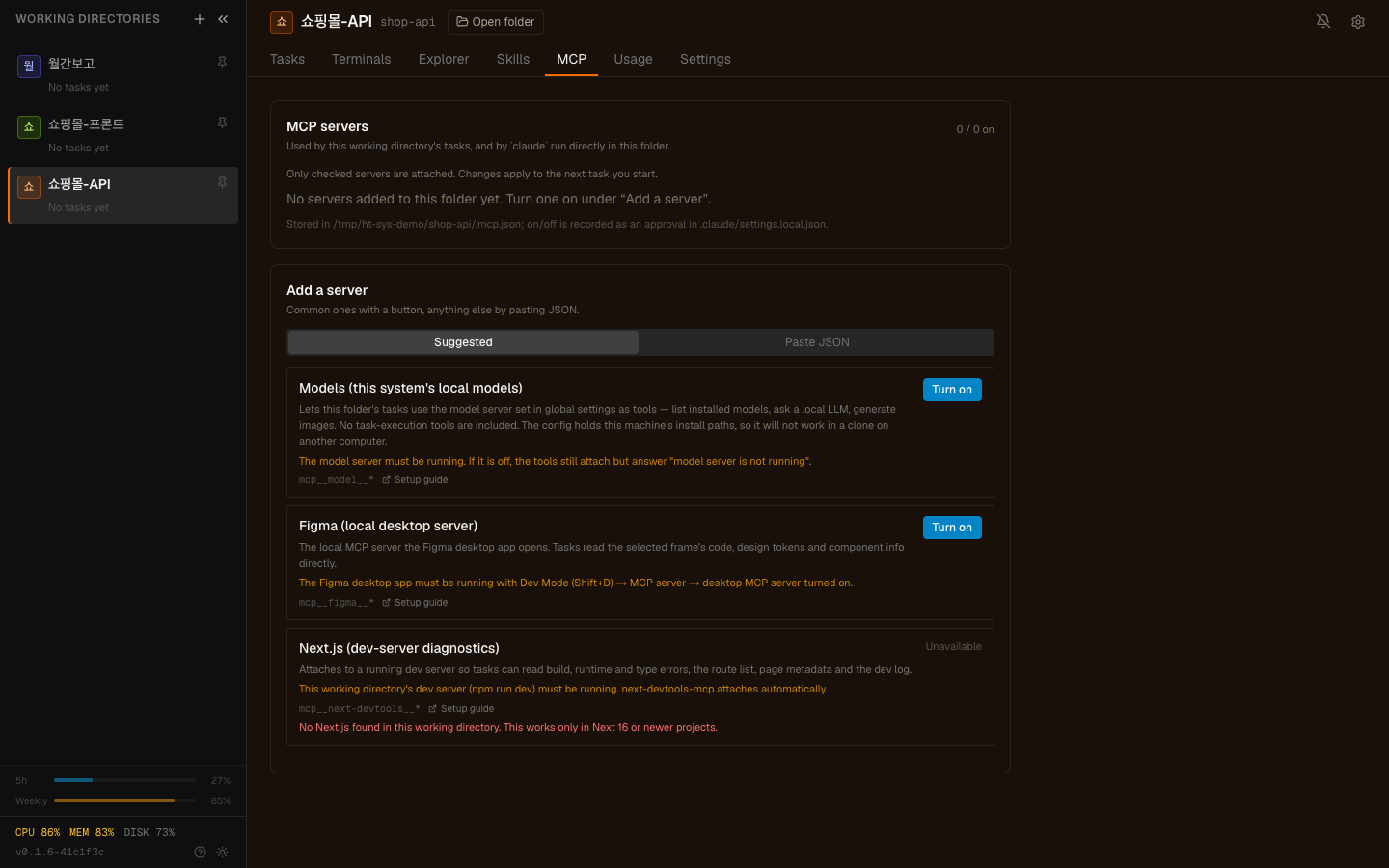
The MCP group under Add a tool in HyperTeams' ⋯ → Tools tab. This is where you turn on the tools this folder's tasks get.
The list inference mode opens, from
the API surfaces chapter.
| Kind | Path |
|---|---|
| List | /v1/models |
| Chat | /v1/chat/completions |
| Completions | /v1/completions |
| Embeddings | /v1/embeddings |
| Moderation | /v1/moderations |
| Speech → text | /v1/audio/transcriptions |
| Text → speech | /v1/audio/speech |
| Audio classification | /v1/audio/classification |
| Image generation | /v1/images/generations |
| Image editing | /v1/images/inpainting |
| Upscaling | /v1/images/upscale |
Audio and images get their own chapter.
graph TD
  A["Your application"] --> B["OpenAI SDK"]
  B --> C1["Commercial API"]
  B --> C2["Your machine · HyperTeams"]
  C1 -.->|"one line of base address"| C2
Develop against local models and run on a commercial API, or the reverse. Configuration, not a code branch.
Run processing that touches customer data or unreleased material on local models. It is the strongest form of things to watch out for saying "use a work environment for work" — it does not leave at all.
Calls that repeat in bulk — embeddings, classification — cost nothing per item locally. Where quality is sufficient, the difference is large.
Compare models by changing only the base address in the same code. Measuring which model fits your data yourself is the most reliable answer.
| Work | Local suitability |
|---|---|
| Classification, tagging | high — repetitive and undemanding |
| Embeddings | high — bulk processing |
| Summarising (short) | high |
| Speech recognition and synthesis | high — see the next chapter |
| Long-document reasoning | medium — depends on model and hardware |
| Complex code writing | low — commercial models lead |
This is model routing locally. Match by difficulty as before, except now there is one more option: your own machine.
Using a commercial API's model name gets you nothing. Check the list first.
Depending on hardware it can be much slower. Timeouts tuned for a commercial API will fail as-is. Measure once and leave headroom.
Get the address wrong so the dashboard calls itself and you are cut off with a
508. That is not a bug but a loop guard — without it, sockets pile up at
every hop. A 508 means check whether the address is your own dashboard.
inferenceDownloading a model or restarting the server returns 404 under inference.
Confirm the action you need really is a management path, and if so you need
full — which is
granting that program management over your model server.
| What you are attaching | base |
|---|---|
| OpenAI-compatible SDKs and tools | …/api/ai/v1 |
| Another HyperTeams dashboard | …/api/ai |
With an SDK it is the first one. The SDK does not append /v1 for you, so it
has to be in the base.
No. Different work suits different options. Split what local is good at (repetitive, bulk, leak-sensitive) from what commercial is good at (hard reasoning, long context). OpenAI compatibility means mixing the two is cheap.
Start with what small models handle — classification, tagging, embeddings. These do not need a large model. Send only the hard parts to a commercial API.
Open a tunnel. But at that moment one key also opens your dashboard. If the goal is sharing models across a team, Connect is the better fit for permission management.
1. What do you change in existing code?
The base address and the key — two lines. Because it is OpenAI compatible, the SDK, streaming, and function-calling code stay as they are.
2. What should you suspect on a 508?
That the address is your own dashboard. It detected a loop of the dashboard calling itself and cut it; without that, sockets pile up at every hop.
3. Which kinds of work suit local models especially well?
Repetitive, undemanding work like classification, tagging and embeddings, and data that must not leave. Hard reasoning and complex code writing still favour commercial models.
Audio and images behave differently, so they get their own chapter → Working with audio and images
from openai import OpenAIclient = OpenAI( base_url="http://localhost:27777/api/ai/v1", # ← this line api_key="<dashboard password>", # ← this line)r = client.chat.completions.create( model="...", messages=[{"role": "user", "content": "Hello"}],)import OpenAI from "openai";const client = new OpenAI({ baseURL: "http://localhost:27777/api/ai/v1", apiKey: process.env.HT_KEY,});curl -H "Authorization: Bearer $HT_KEY" \ http://localhost:27777/api/ai/v1/models HyperTeams